Friday Night Rock-Out: “Listen to Her Heart”

Of the hundreds of kids who graduate from Gainesville High School every year, relatively few (I’m guessing) are aware that they attended the same school as the late, great Tom Petty. (My son Connor definitely was aware because I was constantly reminding him of it, to his annoyance. LOL.) Petty is still Gainesville’s most famous native son, and with good reason. He was one of the greatest rock musicians of his generation. In fact, I think of him as America’s version of David Bowie—brilliant, inventive, always changing and yet always the same.

(Fun fact: one of Gainesville’s other famous sons, Don Felder, taught Petty how to play piano, or guitar, depending on who you ask.)

My favorites of Petty’s songs are the early classics like this one, “Listen to her Heart.” If you’ve ever feared losing a lover to a rival with a lot of money and cocaine (and who hasn’t?), this song is for you.

Rock on…

Friday Night Rock-Out: “Trouble”

Forget Van Halen. Forget Hendrix. Forget Clapton. Lindsey Buckingham is the greatest guitarist in the history of rock music. Don’t believe me? Listen to this song, “Trouble,” from his 1981 solo album Law and Order. If it doesn’t transport you to another plane of existence—yes, forgive the cliche; to an actual soundscape—then you need to get your ears checked.

Buckingham was, of course, the driving force behind Fleetwood Mac’s second incarnation, when they produced one of the greatest rock LPs of all time, Rumours. (When he joined the band, he insisted they also hire his girlfriend, Stevie Nicks, who also had a bit to do with the group’s ultimate success.) As band leader Mick Fleetwood saw at the time, Buckingham is not just an incredible guitarist, he is also a phenomenally talented song-writer, multi-instrumentalist, and singer.

Getting back to his guitar playing, though, let me add that Buckingham uses an usual finger-picking technique—more like a banjo-player—which he employs in a variety of styles and with amazing creativity. That creativity is on full display here. 

Rock on…

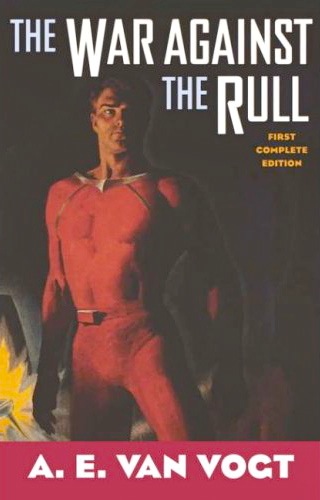
Classic Sci-Fi Book Cover: “The War Against the Rull”

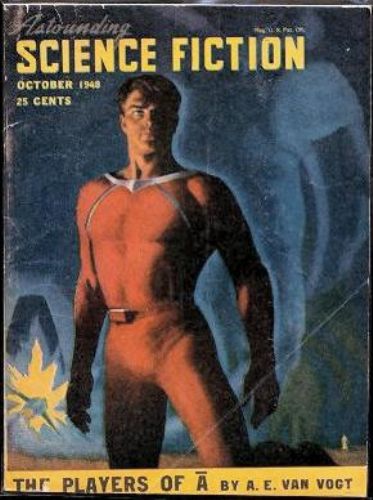
This entry in my on-going Classic Sci-Fi Book Covers series is both old and new. That is, it’s a modern touch-up of the cover from the October 1949 edition of Astounding Science Fiction painted by Hubert Rogers. That issue included a work by A.E. van Vogt, but not the one we are interested in here. This modern version is from a 1999 edition of van Vogt’s classic sci-fi novel, The War Against the Rull, which I distinctly remember devouring in two days when I was in eighth-grade.

I like this cover a lot. It’s not just a classic. It’s an archetype. Specifically, the archetype of the heroic (America) scientist, a buff intellectual and polymath whose ilk could be found in countless works of Isaac Asimov, Robert Heinlein, Roger Zelazny, and on an on. In The War Against the Rull, the man is Dr. Trevor Jamieson, a brilliant scientist who is also a fierce warrior and survival-expert. He’s stranded on an alien planet with a huge, six-legged, intelligent creature called an ezwal who wants to kill him. But when both Jamieson and the ezwal encounter a mutual enemy—a race of aggressive, centipede-like aliens called the Rull—they decide to work together to survive.

It’s a great story, like so many from the sci-fi’s Golden Age. I’ve written before about why sci-fi novels from that era are so much more enjoyable (to me, at least) than most of those written in the last ten years or so. I think it has to do with the gritty humanity of such stories. Yeah, Jamieson is essentially a comic-book character (think Doctor Quest and Race Bannon rolled into one), but van Vogt does a great job of making you believe he’s in real trouble. The ezwal, too—he’s a compelling character in his own right. You get involved in the desperate nature of their situation, and you keep reading to see how they will get out of it.

Anyway, check it out if you can…

Original Cover from Astounding
Cover from the 1970 edition that I read as a kid (by artist John Schoenherr)
Another version of the Scientist Hero Archetype (by artist James Bama)

Classic Sci-Fi Book Cover: “This Immortal”

My privious entry in this continuing “Classic Sci-Fi Book Covers” series was also devoted to Roger Zelazny, so please forgive me for double-dipping into the Zelazny well. But I couldn’t resist talking about one of Zelazny’s other great novels, …And Call Me Conrad—published in 1966 as This Immortal. Most people have never heard of it, but it’s an interesting book for several reasons.

For one, it was Zelazny’s first novel, and it has many of his signature obsessions (e.g, ancient mythology mixed with science fiction; a wise-cracking anti-hero who is also an Übermensch; epic fight scenes; etc.). For another, it actually won a Hugo Award, tying in 1966 with a slightly better-known book…Frank Herbert’s Dune. And finally, it’s just a hell of an entertaining adventure tale.

I chose this cover (by fantasy artist Rowena Morrill) because it really captures the sense of the book’s main character, Conrad Nomikos, a world-weary man-of-mystery who might be immortal. (The text suggests that he is at least a century old, and hints that he might be several thousand years older still.) He works as director of a government agency tasked with protecting and preserving the surviving relics of a destroyed earth. A nuclear war referred to by the characters as “The Three Days” has occurred many decades before, leaving most of the planet uninhabitable. The survivors, which include a wide variety of mutants both human and animal, live mainly on islands like Greece, Conrad’s home.

And that’s not even the main subject this wild, wild little book. Conrad is assigned the duty of escorting a group of VIP tourists—including Cort Myshtigo, an alien from the Vega star system whose race has purchased earth as a kind of vast museum—as they tour the planets once great sites (now ruins). Conrad soon realizes that another of the tourists, an Egyptian assassin named Hassan with whom Conrad has befriended in the past, is secretly on a mission to kill the Vegan. Hassan, it seems, has been hired for this task by an obscure, underground political group who want to reclaim earth for humanity. So, Conrad finds himself not only being a tour-guide but also an unpaid protector of Myshtigo—who he hates.

It’s a crazy book, and the cover conveys this craziness well. Though the edition is from 1980, the cover really feels like a 1970s cover, with its vaguely photorealistic painting of a ruggedly handsome dude with great hair (think Roger Staubach in his prime). I also like how Morrill works in the other tropes of the book—its setting among Greek ruins, as well as the presence of some mythological creatures in the background (which, the reader eventually learns, are actually just animals that have been mutated by radioactive fall-out).

It’s a very dated cover, but still a really cool one. Classic, one might say…

R.I.P. Gene Hackman

My parents divorced when I was a little kid. My mom was struggling with mental illness (undiagnosed, at the time) and so I went to live with my father and his new wife, my step-mother Eileen. I saw my mom mostly on the weekends, and we would invariably go to the movies. I probably saw over fifty movies in the theater per year, all with my mom.

I seldom went to the movies with my father, and even more seldomly when it was just the two of us. The last time I remember was in 1992. Eileen was out-of-town with my brother and sister, so Dad and I went to see Clint Eastwood’s Unforgiven. It’s a great movie, and both my father and I loved it. We especially admired Gene Hackman’s performance as the villainous sheriff Little Bill Daggett, who, as Hackman himself revealed, is a kind of precursor to the modern right-wing movement. 

My dad and I went out to dinner after the movie, and we shared our favorite moments from the film. It’s one of my fondest memories. I thought of it this morning when I read that Hackman had died. And I thought of something else, too. It occurred to me that the last movie I saw alone with my mother was also a Gene Hackman film, 1985’s Twice in a Lifetime. It’s about as different a film from Unforgiven as one can possibly imagine, with Hackman playing a completely different kind of character. And yet, it was still Hackman. Still low-key. Still forceful. Still brilliant.

What are the odds that the two last movies I saw with each of my parents alone were both Hackman films? Pretty good, actually. He was in a lot of movies. In fact, you could argue that he was the most versatile, compelling, and attractive character actor in Hollywood history. He played villains and heroes, and everything in between, across genres from action to mystery to sci-fi. In Twice in a Lifetime, he played an unassuming everyman who, on the tail-end of middle-age, leaves his wife to make a new start. He was also Lex Luthor in Superman. And Pop-eye Doyle in The French Connection. And the blind guy in Young Frankenstein

Being a writer of mysteries, I’m particularly fond of Authur Penn’s 1975 film Night Moves, in which Hackman played a world-weary P.I. searching for a missing girl. It’s one of trademark, understated performances, and yet it crackles with energy. That was his gift. 

Godspeed, Mr. Hackman…!!!

What I’m Listening To: “Sorcerer”

One of my favorite films of all time is Michael Mann’s first feature, 1981’s Thief. That movie was not only the beginning of my life-long love of Mann’s movies, but also with the soundscapes of the German band Tangerine Dream, who composed the score. 

When I saw the movie, I had never heard of Tangerine Dream, and thus had no idea that they were one of the iconic avant-guarde bands of the 1970s, producing legendary albums like Phaedra and Zeit. All I knew was their music was hypnotic and unbelievably powerful.

In fact, Tangerine Dream was sort of the Hans Zimmer of their day, creating some of truly great soundtracks. One of their other great scores was for William Friedkin’s 1977 suspense film Sorcerer. If you haven’t seen it, you should check it out. Nominally a thriller, it’s about four guys from totally different backgrounds, all hiding in out from the law in South America. When a local oil platform catches fire, the guys are offered a big payday if they will drive two trucks full of leaky nitroglycerin through the mountains to put the fire out. That’s the stated plot of the film. I have a theory, however, that its really about four guys who are in hell and just don’t realize it yet. They all have much to atone for, and each suffers and grows (or fails to grow) in his own way.

The score brilliantly evokes that sense of menace and evil that lies just around the corner. It’s a great piece to listen to when you’re in a dark and somewhat demented state of mind (or if you want to be in one, for whatever reason).

Friday Night Rock-Out: “Turn to Stone”

If you were to ask a music lover to name the most iconic pop band of the 1970s, their answer would probably be The Bee Gees. And they’d be right–mostly. For about three years, The Bee Gees bestrode the world like a collosus, leading the musical and cultural era that was disco.

But, for my money, it was the Electric Light Orchestra that most defined 70s pop. The creation of musical genius Jeff Lynne, E.L.O. was hit machine that cranked out gold records with regularity. Their songs were all over the radio here Gainesville, and their records were coveted.

And expensive. I remember looking at Out of Blue in the record store and was shocked to see that it was priced at $14.99. (This was back when ten bucks would get you a decent dinner in a real restaurant.)

My favorite E.L.O. song is, of course, “Turn to Stone”, which is the perfect fusion of pop and rock. Cinemaphiles will note that it was this song that P.T. Anderson ended his great film Boogie Nights with.

Rock-on…

The Enduring Genius of Richard Pryor

When I was teenager (ahem, some years ago) I had the good fortune to see Robin Williams perform. He was the lead entertainment for that year’s Gator Growl, the annual pep rally thrown by the University of Florida. At the time, Williams was mainly known as the odd but extremely funny star of TV’s Mork & Mindy. Few were aware that he was first and foremost a stand-up comedian, and even fewer knew just how brilliant—not to mention obscene—his style of comedy could be. So, you can imagine the surprise (and shock) that ensued when he walked out on stage and did his first joke, miming the cocking action of a shotgun as well as the sound: KA-CHICK. “Down here in the South,” he said, “if you hear that sound, you’d better be one fast motherfucker!”

The ensuing performance became a local legend. I remember it as being as incredibly manic and astoundingly creative. William’s comedy was like nothing else around at that time. It wasn’t long before he emerged as the premier comedian of his generation. And, since his suicide in 2014, he has become firmly embedded in our national consciousness as the Greatest Comedian of All Time.

This is a justifiable opinion. For my money, though, there was one comic who surpassed even Williams in his intellect, inventiveness, and sheer genius. This was Richard Pryor.

Continue reading “The Enduring Genius of Richard Pryor”

Five Great Movies about the Press

I’ve been meaning to write a post listing some great movies about the press. Normally, I would make this a “top-10” list, but the fact is that I couldn’t think of that many, unless I resorted to some cheating (yes, Citizen Kane involves the muckraking journalism of the early 1900s, but you can’t really call it a movie about the press). So, here’s my list, from great to greatest…

ThePaper

The Paper

Ron Howard’s 1994 film The Paper focuses on one frantic day in the newsroom of a major metropolitan newspaper. The day begins with a high-profile murder, for which two young African-American men are arrested. Michael Keaton, Glenn Close, and Robert Duvall are the editors who are fighting to uncover the truth—before deadline. The Paper is a bit broad compared to the other entries on my list, but it’s still a fine movie with a great story.

Continue reading “Five Great Movies about the Press”

Classic Sci-Fi Book Cover: “The Left Hand of Darkness”

Ursula K. Le Guin was one of our finest science fiction writers, and The Left Hand of Darkness is probably her best book. Not only did it anticipate by half-a-century the seismic cultural shifts that are currently roiling Western society regarding issues of gender-identity and sexual orientation, it’s also just a damned good sci-fi story.

Set in the far future, it takes place on Gethen, a wintery planet with a post-industrial civilization. Genly Ai is an Earth-man who is sent to Gethen on a diplomatic mission, hoping to convince the locals to join the Ekumen (basically, Le Guin’s version of the United Federation of Planets). Genly’s efforts are frustrated by long-standing, internecine conflicts between the Gethenians themselves, and also by his own difficulty in relating to the local people. People on Gethen are, it seems, are androgenous—serially androgenous, actually, existing as one sex for a part of the month and as females for the other. (As Le Guin beautifully describes, they subtly change their outer physiognomy, depending on which gender they are currently occupying, appearing to be “men” some of the time and “women” at others.)

Even now, it’s a pretty far-out concept, but it was totally mind-blowing in 1969 when the novel came out. Trust me, though—it’s a very exciting book. Genly soon finds himself caught between warring nations and is arrested as a potential spy. He is rescued by Estraven, the former prime minister of one of the countries, who helps Genly escape. They set off on a life-and-death adventure, sledding across the frozen wilderness of Gethen and trying to get to safety. In the process, Genly is forced to come to terms with his own deep-rooted conceptions of sexuality, while Estraven faces the prospect of Gethen being just one small planet in a vast, strange galaxy.

Le Guin is often described as a literary science fiction writer, and it’s true. Her prose and descriptive eye were top-notch, and she was able to weave Big Ideas (Feminism, Taoism, etc.) into her fiction without it feeling like a Humanities 101 lecture. The edition I read had this great cover by veteran illustrator Alex Ebel, which might seem a bit cheesy today but was striking and evocative at the time. I love the way it captures one of the major visual motifs of the novel, that of linked-opposites (light and dark, male and female, good and evil, progressive and reactionary). It’s a great, surreal representation of a great novel.