If you’ve ever gone to a dance club on “Old-Wave Night” when they play the greatest alterna-hits of the late 1970s and 80s, you’ve almost certainly heard this song. I, of course, am old enough to have heard it on its original run, when it still had complete cultural currency. (Personally, I think it still does.)
Killing Joke was not only one of the wittiest and most subversive bands of the era, they were one of the most talented. And hard-hitting. You know you’ve done something right when later classic bands such as Metallica, Soundgarden, Nine Inch Nails, and Nirvana site you as an influence. In fact, Kurt Cobain liked Geordie Walker’s guitar playing so much that he borrowed from it heavily on Nirvana’s great hit, “Come as You Are.” As one of the song’s producers explained,
…we couldn’t decide between ‘Come as You Are’ and ‘In Bloom.’ Kurt [Cobain] was nervous about ‘Come as You Are’ because it was too similar to a Killing Joke song but we all thought it was still the better song to go with. And, he was right, Killing Joke later did complain about it.
They say imitation is the highest form of flattery, right?
I have a confession to make: I dream about shopping malls. Specifically, one shopping mall, the Oaks Mall here in Gainesville.
The “Collapsed Time” Effect of Vaporwave
After my parents’ divorce, I saw my mother mostly on the weekends, and one of our routine activities was to go to the mall. We would have lunch, see a movie, and wander around. Later, when I got into my teens, I spent a lot more time at the mall with my friends. We hit all the usual spots—the arcade, both bookstores (Waldenbooks and B. Dalton’s), the record store, Spencer’s Gifts, the toy store. And we did anything else we felt like.
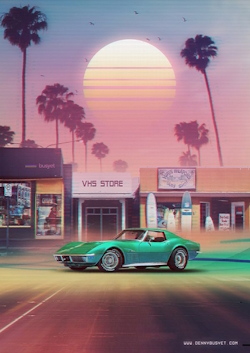
Trappings of the 1980s, along with “Broken Sun” motif
We weren’t alone, of course. After the collapse of downtown America, the mall was the last remaining public square. In suburban America, particularly, it was also the only fun thing to do on a Saturday afternoon. Or a Saturday night, for that matter. When I entered high school and started going on dates, we often went to a movie at the mall. One of my most vivid memories is of how strange and eerie the mall felt after the movie let out at 11:00 or so, and we would walk through the empty, dark hall with all the shops closed and metal gates drawn down. It was one of my first experiences of liminal space, and it sticks with me even today.
In fact, it haunts my dreams. Literally. For when I dream of the Oaks Mall now, I often find myself lost among its corridors near closing time, the wings still busy with shoppers but with the crowd starting to thin out, little by little. Stranger still, my dream-mall is huge—the size of Manhattan Island, practically. A gigantic labyrinth of brand-name stores, all of which are in the early stages of shutting down for the night. (My subconscious, I think, is warning me that the mall is shutting down forever.) These dreams often end in a sense of panic as I realize I am on the wrong side of the mall from my friends, or my car, or whatever, and I will never be able to reach them/it in time before…what? Closing? It’s not clear, but whatever it is, it’s kind of scary.
Despite the disquieting nature of these dreams—or perhaps because of it—I find myself endlessly fascinated by what has come to be known as the Vaporwave aesthetic. Vaporwave is primarily a visual genre, marked by artistic images of 1980s culture. That is, computer graphics, shopping malls, the Miami skyline (alaMiami Vice), fast food restaurants, music videos, video stores, and old-style video games.
And neon. Lots and lots of neon.
Empty Mall / Liminal Space Vibe Typical of Vaporwave
The overriding effect is that of a hyper-real fantasy that feels like a time-portal back to the 1980s. I love these images because they somehow evoke the memory of that long ago time, at least for me. More accurately, they evoke the feeling I wanted to have at the timebutcould never quite capture. The feeling of an endless, prosperous, fun, high-tech future.
I think that this is the real power of nostalgia. A wise man once defined nostalgia as a fondness for a Time that never existed. I don’t think that’s quite right. Nostalgia is a fondness not for a lost time but for a lost hope—the hope one felt and in a familiar place and a long-ago time. A hope that, though never realized, still lingers in the heart.
That sense of lost opportunity is, I think, reflected in the very name of the genre itself, vaporwave, which is very similar to vaporware, a term coined in the 1980s to mean great-looking software that was promised by advertisers and corporations but which never actually materialized. It simply evaporated.
The same thing happened to our collective dreams back in the 1980s. My friends and I all hoped that we could look forward to a glorious future, one better than that of our parents’ and teachers’ generation. A future that would be made bright by the many technological revolutions (the digital revolution, especially) that were impacting every aspect of our culture: movies, TV, music, art, games, fashion, and even books. The haunting images of vaporwave reflect that lost dream—rather than the sterile reality—of the 1980s and ’90s.
Many vaporwave images seem to have a psychedelic “collapsed time” feel to them, as did many of the music videos and computer-generated short films of that era. The hippie generation had the psychedelic flower as their symbol. We had the computer-generated sun—the so-called “broken sun”—which seems to have been pulled directly from of a film poster or a television commercial from 1982.
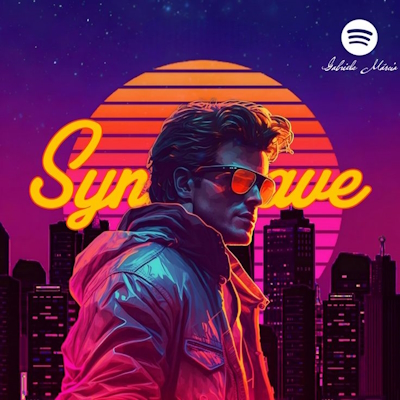
As attracted as I am to vaporwave, I am equally drawn to its parallel music genre, synthwave. Like vaporwave, synthwave is characterized by the early computer-era vibe, as symbolized in synthesized music. Not actual synthesized music from the 1980s, of course, but rather music that sounds a lot like it, yet is somehow drained of all melodrama and false tension that characterized synth-music back then. Synthwave has a kind of purity to it. A simple beauty that surpasses the actual music of that time.
In other words, synthwave is to actual 1980s music what Andy Warhol was to actual advertisements of the 1950s. His silk screen images of Campbell’s soup cans looked almost exactly like actual soup cans, but larger, stylized, more vivid. They made the world really see Campbell’s soup cans—the sublime nature of everything, even a mass-produced soup can—for the first time. Warhol’s genius lay in his ability to show us the beauty and promise of something that was once central and even commonplace in our lives, even as it mocked (lovingly) that very same thing.
That’s what vaporwave does, too. Through the alchemy of art, it somehow humanizes the relentless, corporate-controlled media barrage of the 1980s. For me, and millions of others like me, it is literally the stuff that dreams are made of.
Or were made of, that is. Back in the day.
Lo-Poly, Computer-Generated Background with Broken Sun
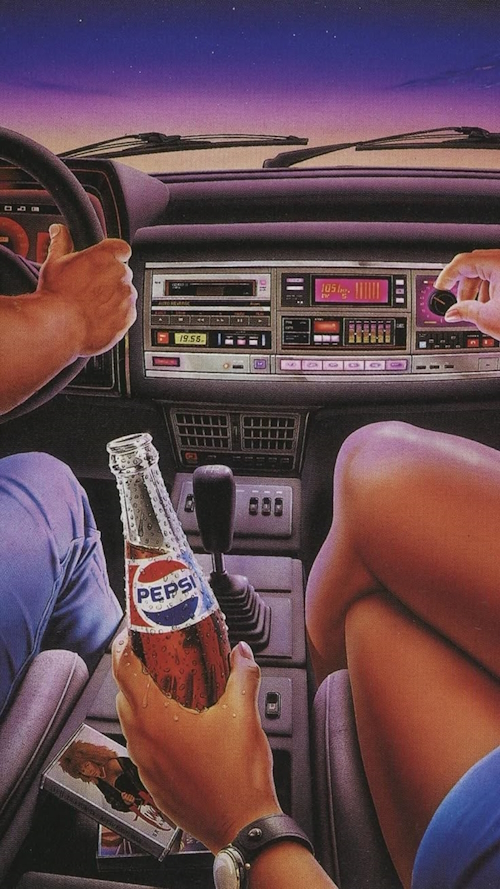
Blatent Consumerism of the 1980s, both celebrated and mocked
Once again, it has taken me far too long to write a short tribute to a fine person who has passed away—Val Kilmer, who died of pneumonia on April 1. This time, it was more than just my workload that explains the delay. I had a bit of trouble discovering what I wanted to say about Kilmer, who was a great actor but also a bit of a cipher. A few years ago, I read his memoir, I’m Your Huckleberry, and I enjoyed it. I was struck, however, by how little Valmer says about his filmmaking experiences. For instance, he barely mentions the production of Tombstone, the film in which Kilmer had his most celebrated film performance—playing the famous gunfighter Doc Holliday—and from which the book’s title is taken. He says even less about the making of Michael Mann’s Heat, in which Kilmer portrays a talented but slightly crazy master-burglar with pitch-perfect ferocity.
This lack of detail was especially disappointing, to me, in part because Heat has my favorite action-sequence of all time—the shoot-out in Century City. More than any other actor in the scene, it’s Kilmer who makes it work, with his fluid transition from cool and controlled bank-robber to machine-gun wielding warrior. I read an autobiography written by a Navy Seal who wrote that he and his comrades once watched Heat together and were impressed by Kilmer’s magazine-changing speed in the film. High praise, indeed.
This reticence on Kilmer’s part to discuss his film-making career—the very aspect of his life that made him famous across the world—suggests to me that Kilmer was deeply ambivalent about being a movie star. I suspect that, like the great Welsh actor Richard Burton, Kilmer was simply too intelligent to think that movie-making was a worthy and serious endeavor. I also suspect that, like Burton, Kilmer was much happier as a stage actor. (His one-man show of Mark Twain was universally praised.)
Unfortunately, his ambivalence somehow bled into his performances whenever he played a leading man, as he did in several major films, none of which was terribly successful. He never seemed to really have his heart in it. But that self-doubt evaporated when he played supporting roles, and these are what he will be remembered for: Iceman in the Top Gun films; Doc Holliday in Tombstone; Chris in Heat. In each of the movies, Kilmer seemed to bring his entire soul to the performance, and he was every inch the movie star.
In any given decade, one or two musicians discovers exactly the right sound, look, and vibe to capture the spirit of the times. Such “triple-threat” artists are rare. Elvis Presley was one. David Bowie was another.
For many in my generation of kids growing up in the early 1980s, there were two such figures. One was Madonna. The other was Billy Idol. Unless you were a teenager in that dark, troubled time, you can’t imagine what a huge impact Idol had on youth culture. Let’s start with his look, an ingenious mix of pre-Goth romanticism (complete with black leather and rosary beads) and science-fiction cyberpunk (he had the same peroxide blond hair and chiseled features as Rutger Hauer’s Nazi replicant in Blade Runner).
Idol looked like…well…an idol. A pop idol, that is. But it was his sound that really mattered. Just as Elvis took the energy and soul of R&B and turned into something that middle-class, white American kids could enjoy, Idol took the punk sound of 1970s London and turned it into kick-ass American hard rock. His early hits like “White Wedding” and “Mony, Mony” stuck out a mile on FM radio (not to mention MTV, where they stuck out two miles). Not only were his songs vicious and fast, they had an actual beat; you could dance to them. And we did.
In short, Idol did what the Sex Pistols never could: he brought punk to mainstream America.
Back in the early 1980s when I was in high school, Wendy O. Williams and The Plasmatics played the annual Halloween Festival Concert at the U.F. Bandshell. I didn’t go, but some of my friends did, and word quickly spread that Williams and the band had played a great set. Also, apparently, Williams bared her breasts, as she was wont to do in concert. In fact, I heard that she had come on-stage wearing nothing on her upper half except a heavy coating of whipped cream (which quickly slid off).
Ahhh, punk rock.
Sadly, Williams’s life ended tragically when she committed suicide in 1998. She battled depression throughout her life, and it finally caught her. Which really sucks, because she sounded like an amazing person. Also, I think she would have had a comeback, at some point. She and the Plasmatics made some incredible music. My favorite of their songs is this one, “Masterplan.”
When I saw Michael Mann’s brilliant film The Insider in 1999, one of the many highlights, for me, came in a pivotal courtroom scene. The film’s protagonist, Jeffrey Weygand, is trying to testify against the tobacco industry with the help of a Mississippi attorney, Ron Motley, played by Bruce McGill. McGill gives a great, over-the-top performance, but it’s matched by that of the guy playing the evil tobacco attorney. When I realized who this second actor was, I almost shouted at the screen, “That’s Wings Hauser!”
It thrilled my heart to see Hauser in an A-list movie, at last. And he was giving an A-list (if brief) performance! On this blog, I write a lot about great B-Movies, and Hauser appeared in more B-movies than any other actor I can think of (except, perhaps, Michael Caine in his “I-need-money” phase). With his country-boy good looks and imposing physique, Hauser ended up playing a lot of villains. Most notably, he played the psychopathic pimp Ramrod in 1982’s Vice Squad with sadistic panache. (Fun fact: that film also features Season Hubley, Kurt Russel’s then-girlfriend, who also appeared in Escape from New York.)
Whatever role he played, though, Hauser was always great. As an actor, he had that rarest and most coveted of gifts—the ability to seem completely real. That is, you never noticed he was acting. He was always convincing, and magnetic, too.
He also did a great turn in 1987’s noir film Tough Guys Don’t Dance, which was critically panned but which I really liked; it’s one of the most gleefully perverse films ever released by a major studio.
Sadly, Hauser passed away last week. He was a great character actor. I’ll miss him.
The power of rock-and-roll transcends language. And that’s a good thing because I don’t speak a word of Japanese. Even so, I love this song. It’s from Japanese punk band The Blue Hearts, and it sounds like something The Ramones might have done, back in the day.
Also, I’m pretty sure it’s about a girl named Linda. Or maybe two girls named Linda. Or maybe one girl named “Linda Linda.” Or maybe…
My privious entry in this continuing “Classic Sci-Fi Book Covers” series was also devoted to Roger Zelazny, so please forgive me for double-dipping into the Zelazny well. But I couldn’t resist talking about one of Zelazny’s other great novels, …And Call Me Conrad—published in 1966 as This Immortal. Most people have never heard of it, but it’s an interesting book for several reasons.
For one, it was Zelazny’s first novel, and it has many of his signature obsessions (e.g, ancient mythology mixed with science fiction; a wise-cracking anti-hero who is also an Übermensch; epic fight scenes; etc.). For another, it actually won a Hugo Award, tying in 1966 with a slightly better-known book…Frank Herbert’s Dune. And finally, it’s just a hell of an entertaining adventure tale.
I chose this cover (by fantasy artist Rowena Morrill) because it really captures the sense of the book’s main character, Conrad Nomikos, a world-weary man-of-mystery who might be immortal. (The text suggests that he is at least a century old, and hints that he might be several thousand years older still.) He works as director of a government agency tasked with protecting and preserving the surviving relics of a destroyed earth. A nuclear war referred to by the characters as “The Three Days” has occurred many decades before, leaving most of the planet uninhabitable. The survivors, which include a wide variety of mutants both human and animal, live mainly on islands like Greece, Conrad’s home.
And that’s not even the main subject this wild, wild little book. Conrad is assigned the duty of escorting a group of VIP tourists—including Cort Myshtigo, an alien from the Vega star system whose race has purchased earth as a kind of vast museum—as they tour the planets once great sites (now ruins). Conrad soon realizes that another of the tourists, an Egyptian assassin named Hassan with whom Conrad has befriended in the past, is secretly on a mission to kill the Vegan. Hassan, it seems, has been hired for this task by an obscure, underground political group who want to reclaim earth for humanity. So, Conrad finds himself not only being a tour-guide but also an unpaid protector of Myshtigo—who he hates.
It’s a crazy book, and the cover conveys this craziness well. Though the edition is from 1980, the cover really feels like a 1970s cover, with its vaguely photorealistic painting of a ruggedly handsome dude with great hair (think Roger Staubach in his prime). I also like how Morrill works in the other tropes of the book—its setting among Greek ruins, as well as the presence of some mythological creatures in the background (which, the reader eventually learns, are actually just animals that have been mutated by radioactive fall-out).
It’s a very dated cover, but still a really cool one. Classic, one might say…
If you took the entire West-Coast noir mystery genre and made it into a great 1980s song, “Welcome to the Boomtown” by David and David would be the result. When I first heard it on the radio in 1986, I went straight out and bought the album. It’s one of the most haunting rock songs ever made, right up there with “Hotel California” (another song about California’s own particular kind of purgatory).
I love the way David Baerwald’s dark, ravaged voice seems to meld with David Rickett’s equally dark, slightly atonal guitar playing. And the lyrics sound like something Ross Macdonald might have written. “Welcome to the Boomtown” is a minor classic.
My parents divorced when I was a little kid. My mom was struggling with mental illness (undiagnosed, at the time) and so I went to live with my father and his new wife, my step-mother Eileen. I saw my mom mostly on the weekends, and we would invariably go to the movies. I probably saw over fifty movies in the theater per year, all with my mom.
I seldom went to the movies with my father, and even more seldomly when it was just the two of us. The last time I remember was in 1992. Eileen was out-of-town with my brother and sister, so Dad and I went to see Clint Eastwood’s Unforgiven. It’s a great movie, and both my father and I loved it. We especially admired Gene Hackman’s performance as the villainous sheriff Little Bill Daggett, who, as Hackman himself revealed, is a kind of precursor to the modern right-wing movement.
My dad and I went out to dinner after the movie, and we shared our favorite moments from the film. It’s one of my fondest memories. I thought of it this morning when I read that Hackman had died. And I thought of something else, too. It occurred to me that the last movie I saw alone with my mother was also a Gene Hackman film, 1985’s Twice in a Lifetime. It’s about as different a film from Unforgiven as one can possibly imagine, with Hackman playing a completely different kind of character. And yet, it was still Hackman. Still low-key. Still forceful. Still brilliant.
What are the odds that the two last movies I saw with each of my parents alone were both Hackman films? Pretty good, actually. He was in a lot of movies. In fact, you could argue that he was the most versatile, compelling, and attractive character actor in Hollywood history. He played villains and heroes, and everything in between, across genres from action to mystery to sci-fi. In Twice in a Lifetime, he played an unassuming everyman who, on the tail-end of middle-age, leaves his wife to make a new start. He was also Lex Luthor in Superman. And Pop-eye Doyle in The French Connection. And the blind guy in Young Frankenstein.
Being a writer of mysteries, I’m particularly fond of Authur Penn’s 1975 film Night Moves, in which Hackman played a world-weary P.I. searching for a missing girl. It’s one of trademark, understated performances, and yet it crackles with energy. That was his gift.