Recently I chatted with my friend Jeff Circle on his excellent “The Writer’s Dossier” podcast. We discussed topics ranging from growing up in Gainesville to 80s music to crime fiction. I had a great time, even though I was slow to grasp the concept of “rapid-fire responses.” Oh, well. I’m getting old.
I had an event to attend in New York City last week, but I couldn’t afford the hotel when the event was actually being held. So, I got a room for my wife and me a few blocks north, on 7th Avenue and 53rs Street. Venturing out for coffee the next morning, I was thrilled to see a sculpture directly across the street, a giant rendering of the word HOPE in red and green letters.
The sculpture is, of course, by pop-artist Robert Indiana, and is a version of his famous LOVE print from 1964. With its simple, Didone letters and bright, primary colors, it’s one of the most instantly recognizable images in art history. Later, Indiana transformed the image into a sculpture which was installed in Central Park for decades. Later still, he made parallel sculptures using other words, like the HOPE version I saw (and photographed, below).
For me, seeing that particular sculpture, in that particular spot, literally right outside my randomly chosen hotel, seemed like a profound instance of synchronicity. This is because I had been reading Prudence Peiffer’s excellent non-fiction book The Slip: The New York City Street That Changed American Art Forever, which illuminates the history of Coenties Slip (pronounced koh-ENT-tees), a semi-abandoned industrial area of lower Manhattan that had once been a small pier jutting into the East River. The slip was filled-in during the early 19th Century and became a locus for sail-making, one of the most skilled and highest-paying trade jobs of the era. Sail-making requires a lot of open warehouse space, and in the early 1960s, those same warehouses (long since abandoned) became cheap studio space for struggling artists and actors, and it is these brave figures that Peiffer’s book illuminates. Chief among them were Robert Indiana, James Rosenquist, Agnes Martin, Elsworth Kelly, and Lenore Tawney.
If you’ve ever gone to a dance club on “Old-Wave Night” when they play the greatest alterna-hits of the late 1970s and 80s, you’ve almost certainly heard this song. I, of course, am old enough to have heard it on its original run, when it still had complete cultural currency. (Personally, I think it still does.)
Killing Joke was not only one of the wittiest and most subversive bands of the era, they were one of the most talented. And hard-hitting. You know you’ve done something right when later classic bands such as Metallica, Soundgarden, Nine Inch Nails, and Nirvana site you as an influence. In fact, Kurt Cobain liked Geordie Walker’s guitar playing so much that he borrowed from it heavily on Nirvana’s great hit, “Come as You Are.” As one of the song’s producers explained,
…we couldn’t decide between ‘Come as You Are’ and ‘In Bloom.’ Kurt [Cobain] was nervous about ‘Come as You Are’ because it was too similar to a Killing Joke song but we all thought it was still the better song to go with. And, he was right, Killing Joke later did complain about it.
They say imitation is the highest form of flattery, right?
I had a lot of fun being on the “Do You Remember the First Time?” panel at the Edgar Awards Symposium last week. Panel chair Terry Shames did a great job, and I got to meet some hitherto online-only friends like Audrey Lee. I also made some new ones.
I was pretty nervous and I think it shows, but oh, well. Check it out if you’re interested.
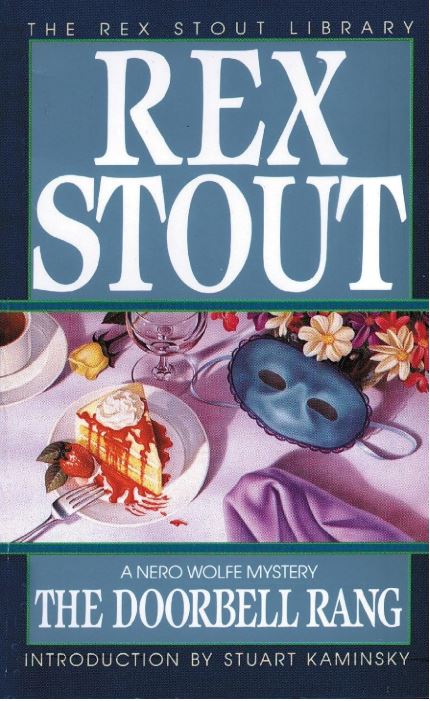
Frequent readers of this blog might remember a post a did some years ago called “My Rex Stout Shout-Out,” and will therefore already know of my long and abiding admiration for Rex Stout. Specifically, for his Nero Wolfe novels, the best of which is perhaps The Doorbell Rang.
It’s one of Stout’s later novels, published in 1960, and it was also the most controversial, involving as its central, unseen villain no other than J. Edgar Hoover himself. And, yeah, that’s one reason I like it. Stout’s detestation of the American right-wing’s tendency toward fascist behavior reached a fever-pitch level, which I share. But the main reason I like the book is for its story, which is actually two interlocking plot lines, each of which complements the other in inventive and surprising ways. The central line involves a very rich widow, Rachel Bruner, who suspects that the FBI is tapping her phones and generally harassing her. She wants Wolfe—the most brilliant man in New York City—to figure out a way to stop them. (Fun fact: this is an example of a little-known sub-sub-sub-genre of detective fiction in which the P.I. serves as a kind of fixer for some rich person’s critical problem.)
Through the intervention of NYPD Inspector Cramer (a highly intelligent but belligerent recurring character, who serves as a frequent foil for Wolfe throughout the series), Wolfe learns that FBI agents are suspects in the murder investigation of a journalist. Thus, Wolfe (and Stout) sees an opportunity to connect these two lines of inquiry. That is, by solving the mystery of the murdered journalist, Wolfe might be able to get some leverage on the FBI, and thus stop its harassment of Mrs. Bruner.
It’s a devilishly clever story, and made even more entertaining by the ways in which Wolfe and his loyal “leg-man,” Archie Goodwin (the narrator of all the Wolfe novels), contrive to outwit the dunder-headed FBI agents. This involves hiring actors to copy the dress and mannerisms of both Archie and Wolfe, so that the actors can impersonate both men and lure the agents into a trap.
Every good story is, in my opinion, a kind of whodunit, if only in a psychological or philosophical sense. Every successful novel asks a question, which the reader must keep reading to discover. With actual mystery novels, this question is explicit—who did the murder and how will the P.I. catch them—but that’s the only real difference. What always amazes me about Rex Stout is how good he is at asking this essential question. In fact, in The Doorbell Rang, he essentially poses it in the opening lines of the book…
Since it was the deciding factor, I might as well begin by describing it. It was a pink slip of paper three inches wide and seven inches long, and it told the First National City Bank to pay to the order of Nero Wolfe one hundred thousand and 00/100 dollars. Signed, Rachel Bruner. It was there on Wolfe’s desk, where Mrs. Bruner had put it. After doing so, she had returned to the red leather chair.
Already, the reader is sucked in. We have to find out what’s the deal with that check, which leads us to the crux of the entire mystery.
This passage also illustrates another great strength of the Nero Wolfe novels—and it ain’t Nero Wolfe. Rather, it’s Archie. Archie’s voice. Smart. Sharp. Sardonic. But a bit noble, too. Take this example from a few paragraphs, later:
After she was in the red leather chair I put her coat, which was at least a match for a sable number for which a friend of mine had paid eighteen grand, on the couch, sat at my desk, and took her in. She was a little too short and too much filled out to be rated elegant, even if her tan woolen dress was a Dior, and her face was too round, but there was nothing wrong with the brown-black eyes she aimed at Wolfe as she asked him if she needed to tell him who she was.
I love that bit about Brunner’s eyes. Archie is, of course, an avowed heterosexual, with some kind of romantic exploit in every book. Yet here he finds himself taken with a woman (an older woman, at that) not for her looks but for her obvious intelligence and determination. It’s a great detail, of the sort Stout always delivers.
It’s also a great example of how vividly drawn Stout’s characters are, especially the recurring characters. The snarky and slightly amoral newspaper editor Lon Cohen. The fastidious and unflappable chef, Fritz Brenner. The cool and precise leg-man Saul Panzer. All of them become as familiar to us over the course of the series, like old friends.
Naturally, Wolfe and Archie manage to pull off the caper, trap the FBI agents, and solve the murder, all simultaneously. I won’t spoil it by giving away the climax of the novel, but trust me…it’s a dozy.
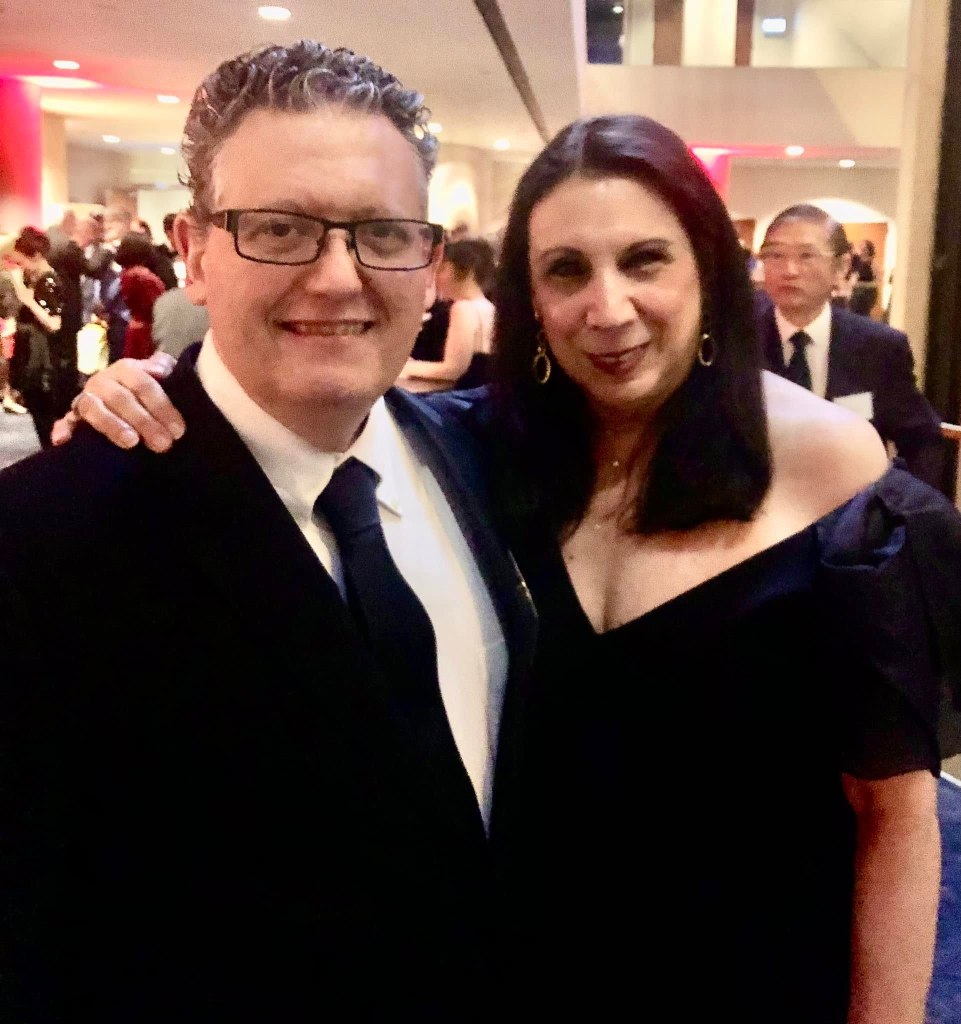
Well, the 2025 Edgar Awards Ceremony is over. I didn’t win my category (that honor went to Henry Wise for his excellent novel Holy City, but I still had a blast. I met a lot of cool people, including my new editor at Crooked Lane, Sara Henry, CLB founder Matt Martz, and others. Best of all, I made some new friends in writers Kerri Hakoda, Audree Lee, and Carol Floriani.
And, for a bonus, Cathy and I got to spend some time in the greatest city in the world, Manhattan. (I am writing this post from inside a Starbucks on 7th Ave.) I used to come here pretty often in the early 2000s, when I was working for software consulting company on Prince Street, and I always loved it. I was last here for fun in 2017 with my son Connor, doing the tourist thing. The city hasn’t changed that much as far as I can tell. It’s still a rambling, teeming, kinetic barrage of sights, sounds, and languages. Manhattan is one of the few places on earth where you can step into a crowded elevator and hear Spanish, French, German, Russian, Hausa, and several others being spoken.
It’s also got the best museum in the world, the Met, which Cathy and I visited, of course. We got to see the John Singer Sargent exhibit, with Sargent’s masterpiece Portrait of Madame X on prominent display. I first learned about this amazing picture (and the scandal it caused) from David McCollough’s excellent history The Greater Journey: Americans in Paris, in which Sargent is one of the Paris-bound artists discussed. (Sargent painted Madame X in Paris with a well-known socialite as his subject; hence the scandal.)
So, all in all, a damn fine trip so far. I don’t know if I will ever get another Edgar nom, but if I do, you can bet I will be back.
For anyone who is a mystery fan and happens to be in N.Y.C. this Wednesday, April 30, you should check out the Edgar Awards Symposium. It’s going to be chock-a-block with guest panels and speakers.
I have a confession to make: I dream about shopping malls. Specifically, one shopping mall, the Oaks Mall here in Gainesville.
The “Collapsed Time” Effect of Vaporwave
After my parents’ divorce, I saw my mother mostly on the weekends, and one of our routine activities was to go to the mall. We would have lunch, see a movie, and wander around. Later, when I got into my teens, I spent a lot more time at the mall with my friends. We hit all the usual spots—the arcade, both bookstores (Waldenbooks and B. Dalton’s), the record store, Spencer’s Gifts, the toy store. And we did anything else we felt like.
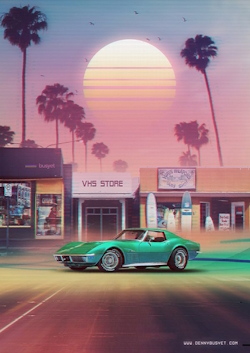
Trappings of the 1980s, along with “Broken Sun” motif
We weren’t alone, of course. After the collapse of downtown America, the mall was the last remaining public square. In suburban America, particularly, it was also the only fun thing to do on a Saturday afternoon. Or a Saturday night, for that matter. When I entered high school and started going on dates, we often went to a movie at the mall. One of my most vivid memories is of how strange and eerie the mall felt after the movie let out at 11:00 or so, and we would walk through the empty, dark hall with all the shops closed and metal gates drawn down. It was one of my first experiences of liminal space, and it sticks with me even today.
In fact, it haunts my dreams. Literally. For when I dream of the Oaks Mall now, I often find myself lost among its corridors near closing time, the wings still busy with shoppers but with the crowd starting to thin out, little by little. Stranger still, my dream-mall is huge—the size of Manhattan Island, practically. A gigantic labyrinth of brand-name stores, all of which are in the early stages of shutting down for the night. (My subconscious, I think, is warning me that the mall is shutting down forever.) These dreams often end in a sense of panic as I realize I am on the wrong side of the mall from my friends, or my car, or whatever, and I will never be able to reach them/it in time before…what? Closing? It’s not clear, but whatever it is, it’s kind of scary.
Despite the disquieting nature of these dreams—or perhaps because of it—I find myself endlessly fascinated by what has come to be known as the Vaporwave aesthetic. Vaporwave is primarily a visual genre, marked by artistic images of 1980s culture. That is, computer graphics, shopping malls, the Miami skyline (alaMiami Vice), fast food restaurants, music videos, video stores, and old-style video games.
And neon. Lots and lots of neon.
Empty Mall / Liminal Space Vibe Typical of Vaporwave
The overriding effect is that of a hyper-real fantasy that feels like a time-portal back to the 1980s. I love these images because they somehow evoke the memory of that long ago time, at least for me. More accurately, they evoke the feeling I wanted to have at the timebutcould never quite capture. The feeling of an endless, prosperous, fun, high-tech future.
I think that this is the real power of nostalgia. A wise man once defined nostalgia as a fondness for a Time that never existed. I don’t think that’s quite right. Nostalgia is a fondness not for a lost time but for a lost hope—the hope one felt and in a familiar place and a long-ago time. A hope that, though never realized, still lingers in the heart.
That sense of lost opportunity is, I think, reflected in the very name of the genre itself, vaporwave, which is very similar to vaporware, a term coined in the 1980s to mean great-looking software that was promised by advertisers and corporations but which never actually materialized. It simply evaporated.
The same thing happened to our collective dreams back in the 1980s. My friends and I all hoped that we could look forward to a glorious future, one better than that of our parents’ and teachers’ generation. A future that would be made bright by the many technological revolutions (the digital revolution, especially) that were impacting every aspect of our culture: movies, TV, music, art, games, fashion, and even books. The haunting images of vaporwave reflect that lost dream—rather than the sterile reality—of the 1980s and ’90s.
Many vaporwave images seem to have a psychedelic “collapsed time” feel to them, as did many of the music videos and computer-generated short films of that era. The hippie generation had the psychedelic flower as their symbol. We had the computer-generated sun—the so-called “broken sun”—which seems to have been pulled directly from of a film poster or a television commercial from 1982.
As attracted as I am to vaporwave, I am equally drawn to its parallel music genre, synthwave. Like vaporwave, synthwave is characterized by the early computer-era vibe, as symbolized in synthesized music. Not actual synthesized music from the 1980s, of course, but rather music that sounds a lot like it, yet is somehow drained of all melodrama and false tension that characterized synth-music back then. Synthwave has a kind of purity to it. A simple beauty that surpasses the actual music of that time.
In other words, synthwave is to actual 1980s music what Andy Warhol was to actual advertisements of the 1950s. His silk screen images of Campbell’s soup cans looked almost exactly like actual soup cans, but larger, stylized, more vivid. They made the world really see Campbell’s soup cans—the sublime nature of everything, even a mass-produced soup can—for the first time. Warhol’s genius lay in his ability to show us the beauty and promise of something that was once central and even commonplace in our lives, even as it mocked (lovingly) that very same thing.
That’s what vaporwave does, too. Through the alchemy of art, it somehow humanizes the relentless, corporate-controlled media barrage of the 1980s. For me, and millions of others like me, it is literally the stuff that dreams are made of.
Or were made of, that is. Back in the day.
Lo-Poly, Computer-Generated Background with Broken Sun
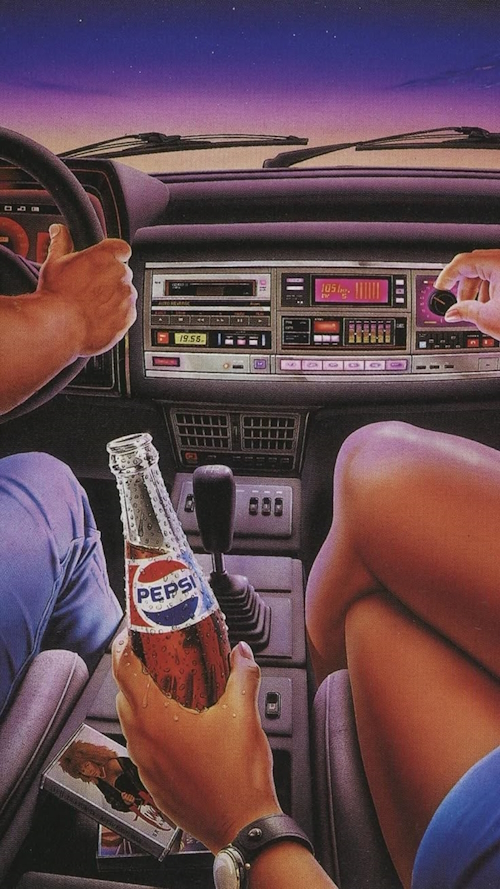
Blatent Consumerism of the 1980s, both celebrated and mocked
Ever since I was a kid I’ve had a deep love for classic murder mysteries like The Maltese Falcon and The Big Sleep. Combine this with my obsession with history and biography—especially Hollywood biography—and you get something like William J. Mann’s Tinseltown: Murder, Morphine, and Madness at the Dawn of Hollywood, the true story of one of the most notorious crimes in American history.
Centered on the still-unsolved killing of director William Desmond Taylor in 1922, Mann’s book comes as close to a “nonfiction novel” as I’ve seen since Truman Capote first coined the term. Being lit geek, I know that 1922 happens to be the year in which The Maltese Falcon is set, and Mann’s story might well have been lifted from one of Hammet’s books, filled as it with hoods, con-men, cops, junkies, sugar daddies and blackmailers.
And beautiful women, of course. Beautiful, deadly women.
The Los Angeles police implicated three women in Taylor’s murder, all actresses of some renown: Mabel Norman, a one-time star whose addiction to cocaine and booze nearly ended her career; Mary Mile Minters, a vapid teenage starlet whose romantic delusions were exceeded only by her considerable box office appeal; and Margaret “Gibby” Gibson, a former Vitagraph player (and occasional prostitute) determined to make herself into a producer.








 Ash Clifton, Writer