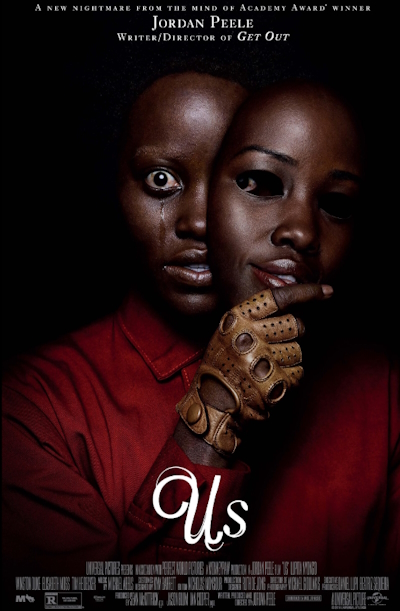
Perfect Films: “Us”

** SPOILERS BELOW **

The better part of a decade has passed since Jordan Peele’s landmark horror film Get Out was released, marking Peele’s transformation from famed comedy writer and sketch artist to one of the most important filmmakers of our time. Peele has since added two more films to his horror oeuvre—2019’s Us and 2022’s Nope

All three are great, but my favorite is Us. For me, it hits on the deepest and most disturbing level, and it has the richest palette in terms of effects. It’s also the hardest to figure out in terms of plot. With Nope and Get Out, the viewer has a vague sense of what’s going on, even early in the film (although the details turn out to be more shocking and terrifying than anyone suspected). But while watching Us, I was totally mystified. I knew it had something to do with evil twins—true doppelgängers in both the literal and the psychological sense—but I had no real idea of what the actual plot would turn out to reveal. And what a reveal it is!

But I’m getting ahead of myself. Part of Us’s appeal lies in its slow-burn first act. (This is true of Get Out and Nope, too, but Us takes it to the next level.) The movie starts with a flashback to 1986, when a little girl, Adelaide, breaks away from her bickering parents at a beach boardwalk and finds a strange funhouse. It’s a simple premise, yet so much disturbing stuff going on in this segment that it’s almost impossible to describe. We have the tension between the parents, raising the specter of divorce (the thing most kids fear more than anything else except death). Then we have the separation of the child from the parents (another primal fear). And, finally, we have the freakish funhouse, which, though apparently deserted, is still lit with eerie neon light.

Continue reading “Perfect Films: “Us””

What Is It Like to be The Terminator?

I can’t believe it’s been 41 years since James Cameron’s The Terminator came out. I first saw it in the movie theater and like everyone else I was completely stunned by its energy and creativity. It might well be the best B-movie action film ever made. (Its sequel, T2, is an A-movie action flick that still feels like a B-movie, in a good way.) Cameron’s spin on what is essentially the ancient hunter-vs.-the-hunted plot—mashed up with about a dozen sci-fi tropes and a heaping serving of the Frankenstein/Dr. Faust myth—results in an almost perfect piece of entertainment. There is not a dull moment or lame moment in it. Every scene either surprises, shocks, or tickles the viewer.

The sequel, T2, is even better, mainly because it’s a coming-of-age film. Rather, it’s a becoming-human film. We watch as the Terminator observes human beings, learns from them, and begins to emulate their best qualities. It’s an archetypal story, and I (almost) tire of watching it. And, in the process of watching the film so many times over the years, I’ve repeatedly asked myself: What is it like to be the Terminator?

Continue reading “What Is It Like to be The Terminator?”

R.I.P. Gene Hackman

My parents divorced when I was a little kid. My mom was struggling with mental illness (undiagnosed, at the time) and so I went to live with my father and his new wife, my step-mother Eileen. I saw my mom mostly on the weekends, and we would invariably go to the movies. I probably saw over fifty movies in the theater per year, all with my mom.

I seldom went to the movies with my father, and even more seldomly when it was just the two of us. The last time I remember was in 1992. Eileen was out-of-town with my brother and sister, so Dad and I went to see Clint Eastwood’s Unforgiven. It’s a great movie, and both my father and I loved it. We especially admired Gene Hackman’s performance as the villainous sheriff Little Bill Daggett, who, as Hackman himself revealed, is a kind of precursor to the modern right-wing movement. 

My dad and I went out to dinner after the movie, and we shared our favorite moments from the film. It’s one of my fondest memories. I thought of it this morning when I read that Hackman had died. And I thought of something else, too. It occurred to me that the last movie I saw alone with my mother was also a Gene Hackman film, 1985’s Twice in a Lifetime. It’s about as different a film from Unforgiven as one can possibly imagine, with Hackman playing a completely different kind of character. And yet, it was still Hackman. Still low-key. Still forceful. Still brilliant.

What are the odds that the two last movies I saw with each of my parents alone were both Hackman films? Pretty good, actually. He was in a lot of movies. In fact, you could argue that he was the most versatile, compelling, and attractive character actor in Hollywood history. He played villains and heroes, and everything in between, across genres from action to mystery to sci-fi. In Twice in a Lifetime, he played an unassuming everyman who, on the tail-end of middle-age, leaves his wife to make a new start. He was also Lex Luthor in Superman. And Pop-eye Doyle in The French Connection. And the blind guy in Young Frankenstein

Being a writer of mysteries, I’m particularly fond of Authur Penn’s 1975 film Night Moves, in which Hackman played a world-weary P.I. searching for a missing girl. It’s one of trademark, understated performances, and yet it crackles with energy. That was his gift. 

Godspeed, Mr. Hackman…!!!

The Scientist Hero: Our Newest Cinema Archetype

Martian3

One of my favorite movies of the last twenty years is Ridley Scott’s The Martian. It’s a science-fiction/adventure movie about an astronaut (Matt Damon) who becomes stranded on Mars after his comrades leave him for dead. Marooned on a barren, hostile world, he has to use his brains and ingenuity to survive until his friends come back to rescue him. By the end of the movie, he has survived dust storms, explosions, freezing temperatures, and starvation.

How does he overcome all these challenges?

Science.

The story is familiar, of course. It has many antecedents, including with the original stranded-on-an-island novel, Robinson Crusoe, and also (more directly) to a great B-movie Robinson Crusoe on Mars. In that classic 1964 cheese-fest, the hero survives by finding a Martian cave full of air where plants still grow, water still flows, and there’s a steady source of light (which is never explained). He even befriends an alien who is also trapped on the planet.

Continue reading “The Scientist Hero: Our Newest Cinema Archetype”

R.I.P. David Lynch

Photo by Alan Light, CC BY 2.0

It has been a week since David Lynch passed away, and many great tributes have already been written about him. I’m tempted to say that I needed a week to process his passing and figure out what I wanted to say about him, but the truth is I was just too damned busy to write anything. In fact, I knew instantly what I wanted to say—simply, that Lynch was a very important person in my life, and in the lives of many of my friends.

I was a college English major in 1986 when Blue Velvet came out, and it hit me and my circle of arty friends like an atomic blast. I already knew of Lynch’s work (I was one of the few kids to see The Elephant Man, and in an actual movie theater, no less), and I knew that he was a director of enormous visual and thematic power. But even I was unprepared for Blue Velvet. On the one hand, it’s a murder mystery, an homage to the noir films of the 1950s in which an unsuspecting suburban kid discovers a hidden world of violence, evil, and, (of course) depraved sexuality. On the other hand, it’s a surrealist vision of the inner world of a modern young man (and, probably, many young women). I was roughly the same age as the main character, Jeffrey Beaumont, in 1986, and so the film had special resonance. I felt like the landscape of my own imagination was a strange blend of the beautiful and the grotesque—often in the same image. And that’s exactly what the film captures, somehow.

Continue reading “R.I.P. David Lynch”

Ten Things I Love About “It’s a Wonderful Life”

GeorgeAndZuzu

1.) Alternate Realities  One of the great things about living in a university town is that you get to hear some great lectures by famous people—for free.  Back in the 80s, I attended a lecture on the subject of evolution by the late, great Stephen Jay Gould.  He talked about how incredibly subtle mutations in the gene pool can, over time, create titanic changes in the history of earth.  He called this the Phenomenon of Contingency.  To illustrate his point, he mentioned two movies that deal primarily with the subject of an individual’s impact on the course of history—the way small choices can resonate through the future.  The movies he sited were It’s a Wonderful Life and Back To The Future.  He might have mentioned a dozen or so works of modern science fiction, or the Hindu concept of the Net of Jewels.  Or all of Buddhism, for that matter.  But he was right on the money with It’s a Wonderful Life.  The movie is about keeping your eye on the Cosmic View, rather on selfish or ego-centric desires.  George has forgotten how much good he had done in Bedford Falls because the effects of his actions have been blurred by time.  Clarence the Angel reveals (or re-reveals) it to him.

Continue reading “Ten Things I Love About “It’s a Wonderful Life””

Let’s Deconstruct an Ad: “Hello Apple Vision Pro”

The ad starts with a thirty-something blond man standing in the kitchen of what appears to be an expensive, post-modern home, spacious and bright, with some well-manicured trees visible through the bay windows. Dressed in a tasteful-yet-generic linen shirt, the man is vaguely handsome yet nerdy. With his Germanic features, beard, and shoulder-length blond hair, he looks a bit like Thor, if Thor were retired and had become a web designer. In other words, he seems to represent the best-case scenario for a lot of aging tech-bros. Sure, your features might have sagged a little, and you might have a bit of a paunch, but you’re still a stud.

The opening shot shows the man slipping on what appears to be an extra-large set of ski goggles, with some strange, high-tech Whangdoodles on the side. This is, we instantly realize, the product that the ad is hawking—Apple latest virtual reality headset, the Apple Vision Pro. Meanwhile, the soundtrack is taken up by the opening ostinato of Supertramp’s “Dreamer,” a song once beloved by the late 70s, post-Vietnam counterculture but which has now been co-opted by the Apple Corporation. Indeed, the song sets the theme for the entire ad. The man we are looking at is the “dreamer,” but we, the viewers, are too. We are all, the ad suggests, preparing to enter a world of high-technology magic, where our entire lives will be transformed (for the better, as in a dream) by this newest gizmo.

Continue reading “Let’s Deconstruct an Ad: “Hello Apple Vision Pro””

Ten Things I Love About “Forbidden Planet”

Author’s Note: A few days ago I saw that a remake of the sci-fi classic Forbidden Planet is in the works. So, I thought I’d repost a short essay I wrote about it some years back on my old blog, Bakhtin’s Cigarettes. Enjoy!

fb_1

The first DVD I bought was Blade Runner. The second was Forbidden Planet. This latter film is a science fiction classic from Hollywood’s second golden age, 1956 (the same year that John Ford’s landmark film The Searchers was released).  Perhaps the definitive pulp sci-fi movie, it’s got everything you might expect: stalwart heroes, spaceships, lasers, aliens, a teen-aged hottie, a mad scientist, and even a talking robot.

And monsters, of course. Monsters from the Id.

Ever since I first saw Forbidden Planet on TV when I was kid, I’ve loved it.  Here are ten reasons why…

1.) Altair IV

Forbidden Planet is, to my knowledge, the first Hollywood movie to depict human beings landing a spaceship on a planet of another star. This was a fairly landmark achievement in the history of science fiction cinema, made even better by the film’s two art directors, Cedric Gibbons and Arthur Lonergan. In their vision, Altair becomes a green- and blue-tinged desert, not unlike that of John Ford’s American Southwest. Considering this was done with matte paintings and other pre-CGI effects, it’s amazing how good the landscapes are, so desolate and full of foreboding.  It’s a prefiguration of all the wild worlds of Star Wars, Star Trek, and so on, yet to come.

Continue reading “Ten Things I Love About “Forbidden Planet””

The Enduring Genius of Richard Pryor

When I was teenager (ahem, some years ago) I had the good fortune to see Robin Williams perform. He was the lead entertainment for that year’s Gator Growl, the annual pep rally thrown by the University of Florida. At the time, Williams was mainly known as the odd but extremely funny star of TV’s Mork & Mindy. Few were aware that he was first and foremost a stand-up comedian, and even fewer knew just how brilliant—not to mention obscene—his style of comedy could be. So, you can imagine the surprise (and shock) that ensued when he walked out on stage and did his first joke, miming the cocking action of a shotgun as well as the sound: KA-CHICK. “Down here in the South,” he said, “if you hear that sound, you’d better be one fast motherfucker!”

The ensuing performance became a local legend. I remember it as being as incredibly manic and astoundingly creative. William’s comedy was like nothing else around at that time. It wasn’t long before he emerged as the premier comedian of his generation. And, since his suicide in 2014, he has become firmly embedded in our national consciousness as the Greatest Comedian of All Time.

This is a justifiable opinion. For my money, though, there was one comic who surpassed even Williams in his intellect, inventiveness, and sheer genius. This was Richard Pryor.

Continue reading “The Enduring Genius of Richard Pryor”

Five Great Movies about the Press

I’ve been meaning to write a post listing some great movies about the press. Normally, I would make this a “top-10” list, but the fact is that I couldn’t think of that many, unless I resorted to some cheating (yes, Citizen Kane involves the muckraking journalism of the early 1900s, but you can’t really call it a movie about the press). So, here’s my list, from great to greatest…

ThePaper

The Paper

Ron Howard’s 1994 film The Paper focuses on one frantic day in the newsroom of a major metropolitan newspaper. The day begins with a high-profile murder, for which two young African-American men are arrested. Michael Keaton, Glenn Close, and Robert Duvall are the editors who are fighting to uncover the truth—before deadline. The Paper is a bit broad compared to the other entries on my list, but it’s still a fine movie with a great story.

Continue reading “Five Great Movies about the Press”