Author’s Note: There has a been a lot of really cool UFO news lately (especially this article), so I thought I would re-share an old post I wrote some years ago regarding a fine book on the subject. Enjoy!
From 1989 to 1992 I went to graduate school at the University of Arizona. This was around the same time that Fife Symington was elected governor of that fine state. I don’t remember having any opinion of Symington at the time, except that he seemed a man very much in the mold of Arizona politicians: a conservative, folksy cowboy.
So it was probably not that big of a surprise when, six years later, Symington handled an unusual political crisis in what many saw as a callous, flippant way. The crisis in question was a UFO—literally, an unidentified flying object—that was spotted by hundreds of people in the Phoenix area on the night of March 13th, 1997. The incident, which has since become known as The Phoenix Lights UFO Incident, resulted in dozens of 911 calls and hundreds of letters being written to the governor. Eventually, Symington was forced to hold a press conference about the event, in which he essentially laughed-off the whole affair. (One of his aides came to conference dressed as a green alien. Hilarity ensued.)
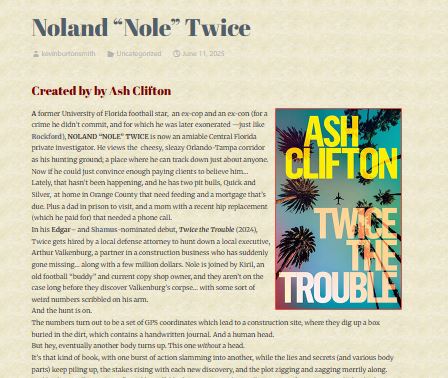
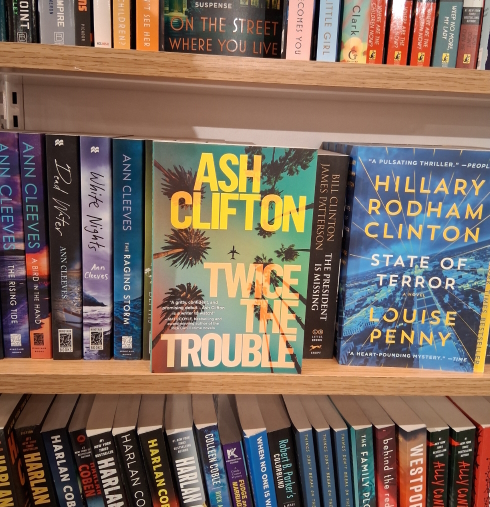
Ever since the paperback edition of my mystery thriller book, Twice the Trouble, came out in August, the price of the hard-cover edition has dropped through the basement. That’s bad for me but good for you (assuming you like hard-cover mysteries). It’s currently on sale for $6.00. Yes, that’s six Ameroes. Cheap!
It would make a great Christmas gift. I’m just sayin…
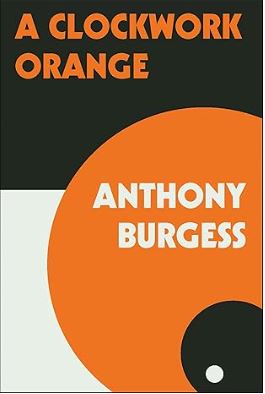
The most important novel in the dystopian science fiction sub-genre is George Orwell’s 1984. The second most important is Anthony Burgess’s A Clockwork Orange. I would go so far to argue that Burgess’s book has, in some ways, been even more influential and culturally significant than Orwell’s, especially for those generations that grew up in the 1970s and later.
It was in 1971 that Stanley Kubrick adapted the book into a landmark film, which was how I first discovered the novel. By the time I was a teenager, in the early 80s, Kubrick’s movie had taken on cult status—almost as much as 2001: A Space Odyssey. My friends and I all loved the movie. And I, being a particularly bookish kid, decided to check the novel out, too.
The secret to A Clockwork Orange’s success, topping that of almost all other dystopian novels, is that it has a great, exciting twist. Its protagonist, a fifteen-year-old delinquent named Alex, seems more like a villain than a hero. He is, after all, a thug, a thief, a gang-member, a rapist, a drug user, and a lover of all things violent (“ultraviolence,” as he and his gang friends call it). Yet, in comparison to the oppressive, authoritarian, end-stage-Capitalist society in which he lives, he is a kind of hero. Against that iron-grey backdrop, his better, human qualities come to the fore—his intelligence, his ferocious courage, and his absolute dedication to personal pleasure, the state-be-damned.
This twist is one of the greatest, central ironies in modern literature, and it’s the reason teenage boys (and probably a few girls, too) continue to find themselves drawn to the book, just as they have been for sixty years. Conversely, this is also the reason that social conservatives have hated the book for just as long. In fact, as I recently learned from openculture.com, A Clockwork Orange was the most banned book of the 2024-25 school year.
I have no doubt that Burgess would have been very, very proud.
Kubrick’s film version was so powerful that it influenced the cover-design for most subsequent editions of the book. Many of these covers were thinly-veiled riffs on the movie poster or on Malcolm McDowell’s brilliant performance, wearing his singularly perverse, false-eyelash. I really like this cover from 1995 by Robert Longo because it bucked that trend and did something new.
Also, I think it really captures the madness of the book—the ferocity of Alex’s character as he rages against the machine. Yes, he’s an evil character, but that’s sort of the point of the whole book. Alex has a God-given right to be evil, if that’s his choice. Evil is an implied, but not a necessary, product of his free will, and he fights valiantly against being “programmed” by the cold authority figures of the story.
Just like most teenagers. Even the ones that aren’t psychopaths.
Many thanks to Cara Putman for interviewing me on her excellent Book Talk podcast. She’s a great writer and interviewer and I’m very grateful. Please check it out.
As I was working on a recent post about the great sci-fi and fantasy movies of 1982, I re-read the Wikipedia page on one of those films, Conan the Barbarian. It’s a great movie, despite the fact that it’s really just a raunchy, gory, over-the-top B-movie with an A-movie budget. I loved it when it came out, as did millions of others. It was, in fact, a culturally significant film, in its own way, and the Wiki page reflects this. A lot of passionate, obviously smart people have contributed to the page over the years. (Wikipedia is, imho, the single greatest triumph of the internet, but that’s a subject for another post.)
Of course, the page inevitably includes a rather insightful section called Themes, in which people have enumerated the topics that the film explores—or at least seems concerned with. These include “The Riddle of Steel,” “Death,” “Wagnerian Opera,” “Individualism,” and “Sex.”
I’m sorry, but “Sex” is not a theme of this movie, nor any other. Neither, for that matter, is “Death.” It’s a topic, surely, perhaps even a motif. (Note that I’m using the word “motif” in its strictest, compositional sense, as it is referenced in musicology.) But it’s not a theme.
Yeah, I know. I’m being a bit of an English-major-snob on this one. A word-Nazi. But bear with me, please. If you’re a person who really tries to appreciate literature, either on the page or on film, then the distinction between theme and motif is important. It’s even more important if you’re a fiction writer who struggles to create books that have some meaning and not mere entertainment that is purely disposable. Not that there is anything wrong with fiction that is mere entertainment—entertainment is great—but let’s not kid ourselves that it’s the pinnacle that people should aim for.
The film’s Wiki page comes much closer to the idea of a real theme when it discusses “The Riddle of Steel” (although it completely mischaracterizes and misinterprets the real matter at hand). As anyone who has seen the movie knows, The Riddle of Steel is a connundrum—not so much a riddle as a philosophical question—that Conan believes god will ask him when he dies. The question goes something like this: “Which is stronger? The sword, or the hand that wields it?” Or, put another way, “Technology? Or willpower?” “Brute force, or the power of conviction?”
It’s actually a pretty deep question, especially when one considers that film’s original script writer, Oliver Stone (who later went on to direct a few films, himself) is a veteran of the Vietnam War, which surely represented one of the greatest struggles of all time between technology, on the American side, versus sheer determination and courage on the North Vietnamese side. (Please don’t write to me and tell me that determination and courage were displayed on both sides of that tragic war. I realize this, and I am over-simplifying the conflict for the sake of argument.)
This posing of a philosophical and moral question, which the hero of the film (and, thus, the viewer) struggles to answer is, to my mind, the real definition of a theme. Perhaps the supreme example of this questioning is Raymond Carver’s classic short story, “What We Talk About When We Talk About Love,” in which three couples—all in late middle-age, all alchohic, and all jaded—discuss the definition of “love” over drinks. It’s a great story, not just because it captures the individual voice and attitude of each character, but also because all of the characters seem to be genuinely struggling with something—a matter of real import that, each one senses, will reveal something about their own lives. As one might expect, each character has their own story to tell about the subject, beginning with this one from a woman named Terri.
Terri said the man she lived with before she lived with Mel loved her so much he tried to kill her. Then Terry said, “He beat me up one night. He dragged me around the living room by my ankles. He kept saying, “I love you, I love you, you bitch.” He went on dragging me around the living room. My head kept knocking on things.” Terri looked around the table. “What do you do with love like that.”
She was a bone-thin woman with a pretty face, dark eyes, and brown hair that hung down her back. She like necklaces made of turquoise, and long pendant earrings.
“My god, don’t be silly. That’s not love and you know it,” Mel said. “I don’t know what you’d call it, but I sure know you wouldn’t call it love.”
The story continues around the table, with each character telling their own story about the general subject of “love.”
In Carver’s supremely able hands, each of these stories is shocking, yet rings true. Completely, brutally true. Some of them are also funny as hell, in a gallows-humor sort of way. One of the greatest things about the story, though, is the way it never gives us a definitive answer to the question it asks. To the contrary, the story raises even more questions—deeper meta-questions that the characters, themselves, are unaware of but which we, as readers, are. Is there a single definition for love? Is that question even meaningful? Does love even exist, really, in the cosmic sense? Does it matter?
In the same way, Conan the Barbarian presents its hero with several possible answers to its central thematic question. The first is given by Conan’s father (played by the great character actor William Smith) in the opening scene, where he tells the young Conan that the one thing he can ever depend on. “Not men. Not women. Not beasts. This,” he says, gesturing to a sword he has just forged. Of course, he is not talking about that particular sword, or even swords in general. He is, we sense, talking about all the intangible things for which the sword is a symbol—discipline, training, courage. The martial ideal.
Later in the film, the villainous Thulsa Doom presents Conan with another answer. In that famous (and surprisingly shocking, even now) scene when he beckons one of his followers to literally jump off a cliff, he suggests that control over the human mind—through dogma, religion, and all the other tools of tyrants—is far more powerful than strength of arms, either literal or metaphorical.
So, which of these answers does Conan accept. Neither! In fact, his tale seems to suggest a third answer, one which is never articulated—never explicitly told—to either Conan or the viewer, but is rather born out by the action of the narrative. The answer, simply, is love. It’s Conan’s love for his murdered parents that sustains him through the ordeal of slavery and drives his desire for revenge. He also loves his friend, Subotai, and he comes to love Valeria even though she is, initially, a rival. Later, it’s Valeria’s love of Conan (along with some help from Subotai) that saves his life after they rescue him from the Tree of Woe. And it’s Conan’s grief over the death of Valeria that causes him to go on his final (foolhardy) confrontation with Thulsa Doom, where he uses his father’s broken sword (note the symbolism, there; steel really isn’t that strong, after all) to behead the man.
I think it is important to note that even in a “silly” genre movie like Conan the Barbarian, good writing can add a level of thematic resonance to any work of fiction. That is, it can turn a potentially crappy movie into a good movie, and a good movie into a great movie. It’s this complexity that separates the vast majority of films (and books, for that matter) from the few we remember years later—that tiny minority that we deem “classics” after the fact.
Another thing to consider is how Conan the Barbarian, like Carver’s short story, doesn’t fully answer its own thematic question. At least, not completely. The ending is ambiguous. Yes, Conan kills the bad guy, and (we are told) ends up a king himself, but he “sits on his throne with a troubled brow.” In others, the verdict is still out on what the real answer to The Riddle of Steel is, after all.This kind of ambiguity is, of course, a hallmark of all good fiction. We, as viewers and readers, don’t get a definitive answer—mainly because the kinds of questions that good fiction asks are, ultimately, unanswerable in any objective sense. They are always about choices. Priorities. Does honor matter more, or friendship? Revenge, or love?
The audiobook for MYOPIC DUPLICITY is out today. The brilliant actor Jenn Lee did the voice narration for my short story. Please check it out here on Audible!!!
As usual, it took us a while, but Margaret and I finally posted our second (and final) book talk episode on Ursula K. Le Guin’s classic sci-fi novel The Dispossessed. I will probably be doing another post on my final thoughts about the book soon. In the meantime, please check out the videos (Part I is here) and give them a like.
In the summer of 1982, I was a very unhappy boy. Being a nerd in an upper-class high school full of preppies and jocks, I didn’t fit in very well. I hated most of my classes. I had a few good, close friends (including some jocks), but that was it. As one would expect, I spent a lot of time in my room reading sci-fi novels and typing short stories on the typewriter my mother had bought me.
The only thing that kept me sane was movies. Fortunately, 1982 turned out to be the most incredible time in cinematic history to be a nerd. A string of classics came out that summer including Blade Runner, The Thing, The Road Warrior (a.k.a. Max Max II), Star Trek II: The Wrath of Khan, Poltergeist, Tron, Conan the Barbarian, and (the 800-pound gorilla) E.T. Even at the time, I was cognizant that this bumper crop of cool films, all coming out within a few weeks of each other, was a very unusual, almost magical development. I spent many hours on the bus with my friends going to and from the local cineplex, where we watched many of these films over and over.
For forty years, I labored under the delusion that this rapid series of classics was just a lucky coincidence. But while reading Chris Nashawaty’s fine nonfiction book, The Future Was Now: Madmen, Mavericks, and the Epic Sci-Fi Summer of 1982, I learned otherwise. A good historian will reveal that any event, no matter how seemingly incredible or unlikely, actually emerges logically from previous events. That is, the seeds were planted years or even decades before. And in 1982, main seed was a little film called Star Wars. As Nashawaty explains:
There’s an unwritten rule for reporters and trendwatchers who cover Hollywood that if you want to know why a movie—or a particular group of movies—was made, all you need to do is look back and see what was a hit at the box office five years earlier since that’s the typical gestation period for studio executives to spot a trend, develop and green-light an imitator, push it into production, and usher it into theaters. And the summer of 1982 would prove no exception, coming exactly five years after Star Wars. What seemed underreported, however, was how this new wave of sci-fi titles had been conceived and carried out. It is a wave that we’re still feeling the aftereffects of, for better and worse, today.
Me with Danni and Michelle of the BCAD Podcast at the Barnes & Noble on Colonial
Well, Cathy and I got back from Orlando on Thursday, and this is the first chance I’ve had to write a post about it. All in all, it was a fine trip! My book talk at Barnes and Noble went well, mostly due to Danni and Michelle, the hosts of the excellent podcast Book Club After Dark, who were nice enough to interview me. They asked great, insightful questions, and I had a lot of fun. The turn-out was modest, but the people who did show up seemed really interested. They asked some great questions, too. It was especially nice to see my old friend Norm, who came to the event to cheer me on. He also snapped the picture above.
Afterward, Cathy and I had a great dinner and some fine beers at the Harp and Celt Pub downtown. The next day, we did a driving tour of Orlando, Noland Twice’s home turf, refamiliarizing ourselves with our old stomping grounds. As one might expect, parts of the city seem completely different from when we lived there, while other parts seemed exactly the same. Overall, O-Town still feels like two cities. There’s the lovely, old, Southern city, with its tree-shaded streets and gorgeous houses from the 1930s and ‘40s. Then, there’s the litter-on-a-stick, urban sprawl of Generica, with its strip-malls and fast-food shacks and liquor stores. And traffic. Lots of traffic. The really sad part about Orlando is that you have to drive through the nasty bits to get to the nice, old, quaint bits. But oh well. I still love the city.
Catchup by the Pool by Slim Aarons (snapped from my phone in Orlando)
When we were done exploring, Cathy and I drove down Mills Avenue and visited the Mennello Museum of American Art, which is perhaps the best small museum I’ve ever visited. I was especially taken with their current exhibit, entitled Pool Party, which had lots of amazing photos and paintings of American pool culture from all over the country. I was especially taken with this 1970 photo, above, by former combat photographer Slim Aarons. It’s titled Catchup by the Pool, and it seems to encapsulate the entire upper-class, White, suburban culture of the U.S., right on the cusp between two equally garish decades. And yet, it’s also kind of…sweet. I find myself wanting to go to this party.
Screen Grab of a Random Speechify Ad from my Youtube Account
And then, just this morning, in one of those instances of synchronicity that seem to happen fairly often to me (and which I blog about, a lot), I happened to be presented with a YouTube ad (for Speechify, of all things). Before the skip button came up, I had to leave the room, so I paused the ad so I wouldn’t miss the beginning of the actual video I was waiting for. (Just to prove I wasn’t crazy, I did a screen grab, above left.)
When I came back, I noticed that there was something weirdly familiar about the freeze-frame that I happened to pause on. If you look at the background, on the wall of whatever apartment or motel room the ad was apparently filmed in, you can see—lo-and-behold!—the same photo by Slim Aarons.
What are the odds? Like, a bazillion-to-0ne! Talk about synchronicity-on-steroids!
Anyway, it seemed like a magical end to a good trip.