
As usual, I was on Wikipedia the other night, looking up one of my favorite rock songs of all time—“Deacon Blues” by Steely Dan. There, I was surprised to learn that the first line of the song, “[t]hese are days of the expanding man,” is a reference to a classic sci-fi novel, Alfred Bester’s The Demolished Man. Donald Fagan apparently said,
The concept of the “expanding man” that opens the song may have been inspired by Alfred Bester’s The Demolished Man. Walter [Becker] and I were major sci-fi fans. The guy in the song imagines himself ascending to the levels of evolution, “expanding” his mind, his spiritual possibilities, and his options in life.
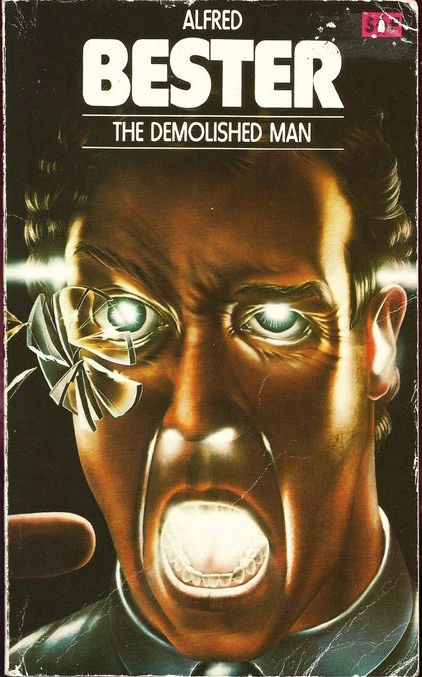
Finding this unexpected reference to Bester’s novel was yet another moment of that Synchronicity for Bookworms phenomomenon that I write about so often, mainly because I had been considering to a post on a great cover I had found for the book. And here it is!
I read The Demolished Man in my late twenties and found it a really bizarre yet engrossing sci-fi novel, one that seems to straddle two eras, “Golden Age” (1940s-50s) sci-fi—with its Buck Rogers’ style future and tropes—and New Wave (1960s-70s) sci-fi—with its trippy, subversive themes and immoral main character. (Roger Silverberg’s The Man in the Maze, which I posted about recently, is very similar in this respect.)
Bester’s novel asks this intriguing question: How does one commit murder in a world where all the police have E.S.P. and can literally read your mind? Yeah, it’s a very, very similar idea to Philip K. Dick’s The Minority Report, which was published three years later. In Bester’s book, people with telepathic abilities—“espers,” who come in ability levels 1, 2, and 3—form a kind of privileged Mandarin caste on 24th Century Earth. They run much of the government and law enforcement with apparent competence, benevolence, and integrity. They may only marry and have children within their own esper class, and they prefer their own company. Most importantly, they can suss out crimes, either before they happen (usually) or afterward (always).
So, what’s a brilliant, daring, sociopathic billionaire like Ben Reich to do when his mind tends toward homicide? The target of his animus is an older business rival, Craye D’Courtney, whom Reich despises with a passion bordering on obsession. Reich devises a cunning plan to kill D’Courtney at a swingin’ dinner party they are both scheduled to attend, and he hires the services of a rare corrupt esper to run interference. Reich also—in one of the book’s cleverest plot devices—pays a corporate jingle-writer to play him the most annoying, brain-embedding ear-worm she has. Reich knows that he won’t be able to get the jingle out of his head, which will temporarily flummox any espers who might try to scan him.
After Reich does the deed at the party, an esper police detective, Lincoln Powell, shows up to investigate. Using a mixture of his esper abilities as well as good old-fashioned intuition, Powell immediately realizes that Reich is guilty of the murder but can’t prove it thanks to the layers of interference that Reich has devised. The rest of the book is like a futuristic episode of Columbo as Powell pursues Reich across the solar system, trying to trap him and reveal his guilt.
If Powell does manage to catch him and prosecute him successfully, Reich faces neither prison nor execution but a fate far worse—“demolition,” the process whereby espers mentally strip a person of their memories and personality so that they might be “rehabilitated” as a productive, normal (non-evil, non-insane) member of society.
In this way, The Demolished Man becomes a very suspenseful inverted detective novel, with the reader breathlessly following Powell and wondering how—or whether—he will catch Reich. I also found myself rooting for the wicked, rebellious anti-hero Reich, which was clearly Bester’s intention. The last half of the book has some genuinely surprising and cool plot twists, and it’s very entertaining overall—especially if you can get past Bester’s very 1950s, conservative, often misogynistic sensibilities (which are very similar, alas, to Robert Heinlein’s).
I really like this 1979 cover by Adrian Chesterman because it evokes the sense of horror (of demolition, presumably, but also of insanity, self-discovery, and other dark things) that pervades the book.
It’s also just really, really trippy.

